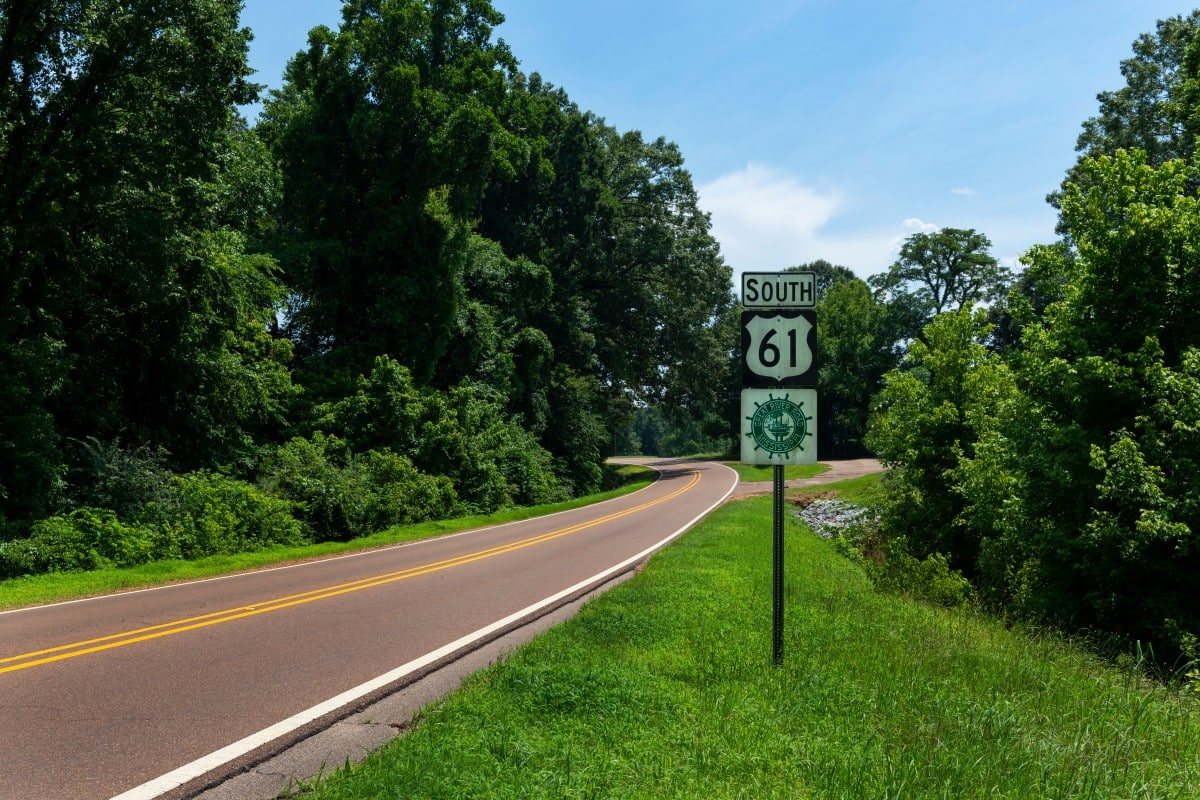
Highway 61 Revisited
Bryan Koemptgen | March 2026
A 26.1-mile stretch of road. That is what separated my two worlds.
Every Friday morning, my grandparents would drive “into town” for errands and return that evening to their home on Clear Lake with me in tow.
It was at the lake that I taught myself how to swim. I fished off the dock. We skated on the ice. My grandfather taught me how to properly build a fire in the fireplace. I dug in dirt and planted things side by side with my grandparents. On Saturday nights, I sat in a swivel rocking chair with my grandma watching Emergency! on TV while she smoked Pall Mall cigarettes. I miss that smell.
On Sundays, my parents and older brothers would come to the lake for hearty Sunday dinners, and I would return home with them.
At the time, it was just a drive. What I didn’t realize was that I was traveling a small piece of one of the most storied roads in America—U.S. Highway 61.
US Highway 61 travels 1,714 miles bisecting the United States north to south from Minnesota to New Orleans. It generally follows the course of the Mississippi River and is designated the “Great River Road” for much of its route. Following the river valley, it became a major agricultural and migration corridor connecting river towns along the way. It is also known as the “Blues Highway,” due to its connections to American blues music and the migration of musicians from the Mississippi Delta to northern cities. Bob Dylan added to the road’s mystique with his 1965 album Highway 61 Revisited. It fused folk songwriting with electric rock, creating a new genre and inspiring countless musicians.
Growing up I did not understand any of that, yet the road was greatly significant to me.
That 26.1 trip via Hwy 61 took between 45-60 minutes. Every time I watched intently out of the car window reading billboards, memorizing street signs and mile markers. I knew all the business, car dealerships, restaurants, and motels along the route. The price of gas at the DX station was $.55 for 9/10 of a gallon. On Sunday drives home, my dad would challenge us to guess the number of stoplights along our route and how many we would have to stop at.
Back home on the East Side of Saint Paul, Hwy 61 was just a busy road that ran through the neighborhood. It was just “there” as my buddies and I spent our days riding our bicycles through wooded trails along the Mississippi River bluffs with Hwy 61 below. We built forts in the woods out of whatever old lumber, large rocks or downed tree limbs we could find. We spent our summer days playing along the banks of Battle Creek. There were rope swings over swimming holes and limestone caves to explore like “The Witch’s Cave” — so deep that I never mustered the courage to make it to the end. A few times a summer we would spontaneously find ourselves on an expedition following Battle Creek all the way downstream as it passed under Hwy 61 and into the Mississippi River. We knew the Mississippi River eventually made its way to the Gulf of Mexico, but that was beyond our world and too much for us to comprehend the significance.
What best characterizes those times was waking up each morning with no plans for the day, no schedule, no particular place to be. Our activities were all self-organized. With no adults in sight, we made up our own games and our own rules. The only adult rule in our world was to “be home when the streetlights come on.”
With the development of the Interstate Highway System in the 1950s-70s — specifically Interstate 55 and Interstate 35 — Hwy 61 was overshadowed, eventually relegated to scenic backroad status. Nonetheless, decades removed from my childhood which was unknowingly shaped by Highway 61, I decided it was time to explore the remaining 1,400 miles of this legendary American highway with the same absence of agenda, schedule, or adult rules that defined childhood.
I floated the idea past a few buddies: “I’m going on a road trip. The only agenda is to drive Hwy 61 from St Paul to New Orleans. I don’t know how long it will take. We will stop wherever we want. We will see what we see, meet who we meet. Do you want to join me?” I assumed this was going to be a solo road trip until my friend Matt responded, “My wife will be out of the country for business, I’m in. If I don’t like it, you can drop me at an airport and I’ll fly home.” I had a companion. I could not back out now.
The night before hitting the road I attended a concert with my son, Ben. The lead singer of Royel Otis came on stage wearing a t-shirt with Bob Dylan’s face across the front. Was it a sign? Coincidence? Foreshadowing? Regardless there was no stopping my own Highway 61 Revisited journey.
The next morning at 8:03am amid light drizzle I pulled up to Matt’s garage, he threw his backpack and cooler into the truck, and the adventure began.
What does one take on such a journey? The truck was haphazardly packed similar to how I might have thought as an 11 year old — camping gear in case we found a place we wanted to camp, inflatable paddle boards if there was a body of water to explore, snacks, water and beer.
Following Highway 61 south first took us through the bluff country of southern Minnesota. Soon after crossing the river at La Crosse, we were in the Driftless Area which I contest is one of the most underrated scenic areas in the United States. It was at our first stop that Matt commented, “That was the most relaxing 4-hour drive I have ever been on. It seems like we just left.” He was right. It’s calming to travel with no particular place to be, no specific time to arrive and without the intensity of driving on the interstate system — maintaining speeds of 70-80 MPH while contesting with other vehicles all in a rush to get somewhere.
Iowa brought the earthy scents of farmers harvesting their fields and historic river towns. And a Honduran café in Davenport that was so delicious we ordered a second round. We skirted around St Louis through what felt like endless green rolling hills and hollers. In Cape Girardeau, a young bartender summed up what we heard from every local, in every town when first asked about their town: “No one moves here. They move away.” Getting deeper into conversation though, none could resist talking about their town with pride. “You must see this. You have to go there.” Proving life in a small town isn’t so bad after all.
Then came Sikeston — a town with one church for every 215 residents — and transmission trouble. The truck limped up to the doors of Autry Morlan Chevrolet at 4:55pm —closing time 5pm. We told the staff the story of our road trip and they stayed late to diagnose the problem. When they could not solve the problem that night, they set us up at the hotel across the highway on their account. By noon the next day they had us back on the road.
Arkansas passed in a blink of the eye as it seemed like merely an extension of southern Missouri as Hwy 61 tries to find the right place to cross the Mississippi River again. (Sorry Arkansas). That river crossing brought us into Memphis where an unexpected highlight was time spent at the super well-curated and impactful National Civil Rights Museum located on the site of the former Lorraine Motel where Martin Luther King Jr was assassinated in 1968.
We could not linger too long in Memphis because just south the Mississippi Delta awaited. The Delta was the most mysterious and anticipated portion of the journey for me — the musical roots and southern cooking have been beckoning me for decades.
We strayed off Hwy 61 onto county roads, surrounded by catfish farms and cotton fields. Cotton floated through the air like a midwinter snow fall. Oh, and the southern hospitality puts Midwest politeness to shame! At The Crossroads in Clarksdale, where legend has it Robert Johnson sold his soul to the devil in exchange for musical prowess, I could not open a door fast enough or get a kind, friendly word out of my mouth before the locals beat me to it. Every person we encountered in the Delta was folksy, generous, and welcoming.
The Delta deals with some harsh realities, though. At Itta Bena we took a detour off Hwy 61 and rolled through the town of 1,500 people. On this sunny afternoon kids were playing, adults were on front porches talking. As we reached the edge of town Matt reflectively stated, “I bet you that this is a really peaceful town.” I didn’t disagree. Thirty minutes down the road, curiosity got to Matt and he pulled out his phone for a quick internet search. What he discovered was different from what we observed. The county was currently under a month-long curfew. A week earlier the FBI had arrested a sheriff’s deputy along with 13 other law enforcement officers across the Delta for drug trafficking conspiracy and accepting bribes. Tragically two days after we passed through 6 people were killed and 10 injured in a shooting after a high school football game in the neighboring town. What we read didn’t match what we had just seen.
South of the confluence of the Mississippi and Yazoo Rivers at Vicksburg, the Delta gave way to pine forests and beautiful antebellum towns. Outside of Natchez was a first for this northerner — seeing a roadside chain gang followed by a trailer proudly adorned with the sheriff’s campaign sign. I half expected the sheriff’s name to be Rosco P. Coltrane.
We could feel our destination getting close as we moved through coastal swamp landscapes along the four-lane stretch between Baton Rouge and New Orleans.
This road trip was always about the journey and not the destination. So, I’m not sure what I expected as we slow rolled up to the southern terminus of US Highway 61 where it meets US Hwy 90.
No marker. No sense of arrival. Just the Orleans Parish Criminal Courthouse, Midcity New & Used Tires, Free Me Bail Bonds and a vacant lot.
We circled the block, consulted Google Maps, and looked at each other.
“Was that really it?”
That was it.
So we did what you do on a road trip with no real agenda and kept going — through the French Quarter and on to a neighborhood hole-in-the-wall for lunch. Over trays of ribs, burnt ends, smoked sausage, slaw, mac & cheese and a few beers at The Joint we commemorated the conclusion of the first half of the journey.
Yes, the first half. We had to turn the truck around and return home before the streetlights came on.
When traveling with no plans everywhere you go, everything you do feels like the right thing because you have nowhere else you’re supposed to be.
It feels a lot like childhood summers.
Back then, the only rule was to be home when the streetlights came on. We didn’t need an agenda. We didn’t schedule meetings or optimize the day. We just let it happen.
Somewhere along the way, we forgot how to do that.
Maybe the third quarter of life isn’t about doing more — it’s about remembering how to do less.
Bonus: Since music was such an inspiration behind this road trip here is the “King of the Road” Spotify playlist created specifically for the road trip.