
Pitch-the-Penny Baseball
Bryan Koemptgen | August 2026
It’s difficult to tell you this story without sounding like an old man pining away for the old days. Simpler days. When kids created their own fun. Adults weren’t around to organize it. We used the resources and space that we had. Yes, it was a time when we left home in the morning and were instructed to be home when the streetlights came on. In between, our parents had no idea where we were or what we were doing.
We ruled the world.
Football was played up and down Longfellow Avenue with a Nerf ball. Mike “Mush” Misukanis was the all-time quarterback. First downs were marked by mailboxes, driveways or fire hydrants. When the season changed, it was street hockey. We dragged the nets into the street and yelled “Car!” when vehicles approached. The nets were pulled to the side. The car passed. Nets went back. Game on.
We rode our bikes through trails in the woods, hitting every corner hard because we knew each twist and turn by heart. Hours were spent playing ping-pong, billiards, Euchre. Slip-n-slide was a special summer day. We explored along the banks of Battle Creek to where it flowed into the Mississippi River.
After dark we played what we called Ditch, an outdoor version of hide-and-seek. Depending on how many kids were playing, we would establish the territory: “Hawkins’ yard to Pignato’s yard, both sides of the street.” Then everyone scattered. The hiding places got increasingly creative. Garage roofs. Trees. Behind air conditioners and wood piles. My favorite was when someone crawled up inside a fishing boat that was upside down on its trailer.
And we played baseball. Countless versions of baseball.
The version of the game depended on who was around, where we were playing and what equipment was available. Wiffle ball until too many house windows were broken each season. Hotbox in the sandbox needed only three players. We created a game called sockball using a pair of tube socks rolled into a ball, covered in masking tape and hit with a tennis racket. Launching the sockball over Craig Chambers’ house across the street brought glory. We used a small patch of grass between the elementary school and rec center for a unique field with its own rules. Hit the swing set behind the shortstop—ground rule double. Roof of the rec center or over the walking path—home run. Pitcher’s hand for a force out. Any hit to the right side of the pitcher—automatic out. Hit a foul ball onto the school roof—automatic out and the batter was boosted onto the roof to retrieve the ball.
Pitch-the-penny baseball took things to a different level.
The game was created by two East Siders in the late 1970s, Todd Soutor and Tom Larson. (Important note for the uninitiated: it’s the “East Side.” There is no such thing as “East St. Paul.”) Todd and Tom were in high school playing American Legion baseball with my older brothers while my dad coached. I was the 11-year-old tag-along at every game, carrying the bat bag and keeping the scorebook on the bench. When you’re 11 or 12 you are not hanging out with high schoolers. Shortly after creating pitch-the-penny, though, Todd shared the game with his younger brother Bradd and the rest of us in the neighborhood.
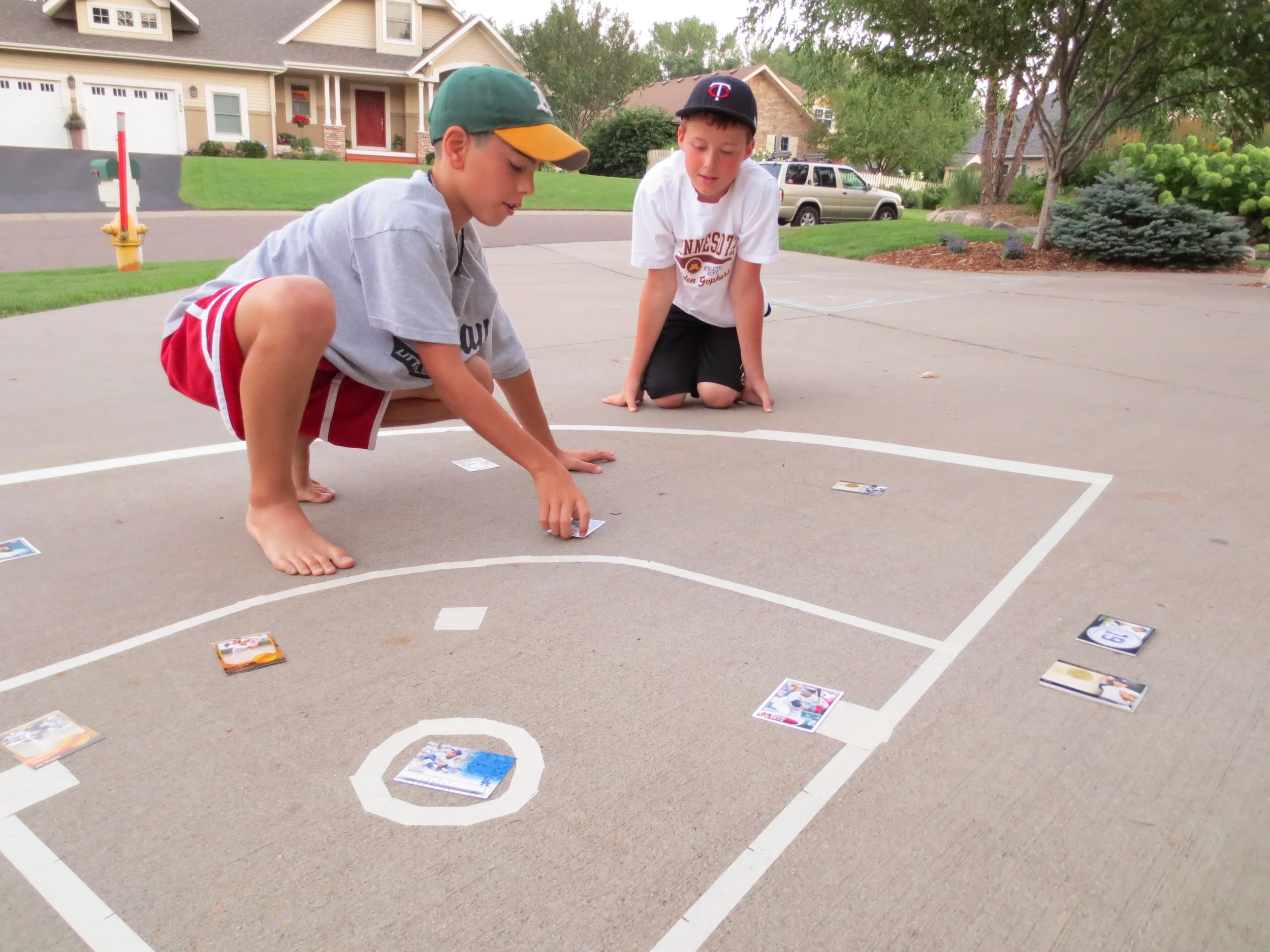
I searched the internet and have not found anything like it. The equipment was simple. A six-sided die. A penny. Baseball cards. Masking tape. And a smooth concrete floor—basements and garages were ideal. We essentially built a miniature baseball field on the floor with masking tape and played the game with baseball cards.
Home plate. First. Second. Third. Baselines. Foul lines. Outfield wall. Pitcher’s mound. Batter’s boxes. Then we added whatever else our stadium needed—dugouts, bullpens, warning tracks, logos.
The baseball cards were positioned around the field like defensive players in a real baseball game. Nine cards. Nine positions. When pitching, the defensive player rolled the die. A 2 or 3 was a strike. A 4 or 5 was a ball. A 1 or 6 meant the batter hit the ball.
That’s when the penny came in. The offensive player sat behind home plate and tossed the penny into the field as if it were the batted ball. Where it traveled and landed determined what happened next. Land in foul territory—foul ball. Go beyond the outfield wall—fly out. Touch a defensive baseball card—out. Land on the tape marking the outfield fence—home run.
If the penny landed safely in the field of play, the play got really interesting. The die determined how many times defensive cards could be flipped toward the ball and how many times offensive cards could be flipped around the bases. Throws were made by putting your index finger on the penny and sliding it across the floor toward another defensive card.
The game was played sitting, kneeling and crawling around the perimeter of the field. There were ground balls. Fly balls. Force outs. Shoestring catches. Stolen bases. Tagging up. Errors. Runners stranded in scoring position. Players benched. Relief pitchers summoned from the bullpen. Players traded to a different team. Baseball.
That’s the basic concept of the game. But we didn’t stop there. We built an entire baseball world around it.
Access to professional baseball was different then. It was years before ESPN. To keep up with what was happening, we scoured the box scores in the St. Paul Pioneer Press newspaper each morning. There was limited exposure to baseball on television. We waited until Saturday morning for This Week in Baseball (TWIB) to be inspired by highlights from the previous week. Was there any greater voice than Mel Allen? TWIB was followed by the Game of the Week on NBC. That was about it until cable television came along and suddenly the Chicago Cubs were available every afternoon on WGN. But even today, who wants to spend a summer afternoon inside watching the Cubs?
For pitch-the-penny we held drafts to form teams. We selected a player for every position, backups at each position and a designated hitter. We had starting pitchers and bullpens. We had bench players and even full farm teams. We exchanged lineup cards. We kept scoresheets and statistics.
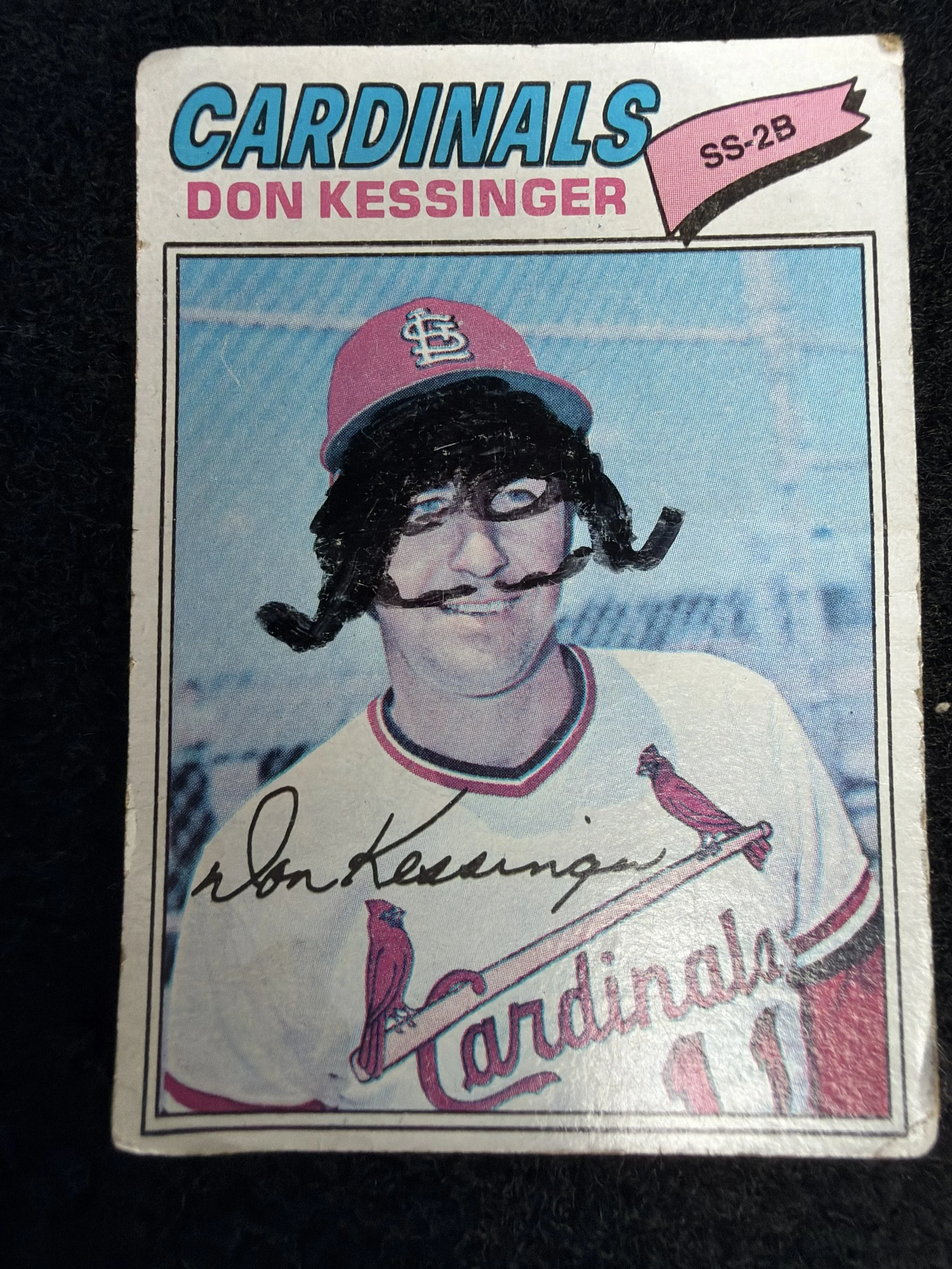
The baseball cards weren’t something we collected and stuffed in a box to occasionally look at. They were players. They pitched. They ran the bases. They chased down and dove for fly balls one card-flip at a time. If a player didn’t perform well in a pitch-the-penny game, some managers were known to pull out a marker and draw glasses or a mustache on his card. We were not thinking about any future value.
We created stories like the ones Mel Allen told us on TWIB. As new situations arose, we debated and then created or amended the rules of play.
We had home games and away games because everyone had a field at their house. Frank Bobick had the most creative stadiums. One had a Green Monster in left field like Fenway Park, made out of thick green masking tape. Playing at Steve Fichtel’s was a big road trip because he lived “down the hill.” Getting there was easy. Riding your bike back home up the hill was the problem. The Soutors’ garage was almost hallowed ground. It was our Yankee Stadium, given its storied history as one of the pitch-the-penny originals.
None of this seemed unusual to us. Masking tape on a concrete floor was a baseball stadium. A penny was a baseball. A baseball card was a player. And riding your bike a few blocks down the hill was a road trip.
I don’t remember the last game. There wasn’t a triumphant final out. We didn’t commemorate the closing of one of our stadiums. Nobody retired. We started high school and just stopped playing.
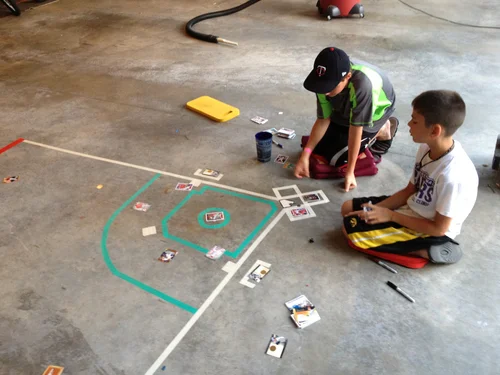
Fast forward a lot of years and I had boys of my own. When Ben and Isaac started showing an interest in baseball cards, I knew what I had to do. One Saturday morning, I grabbed a few rolls of masking tape and constructed a pitch-the-penny field on the garage floor.
I pulled the boys outside, gave them a little history of the game and explained the rules. I’m sure the history was lost on them at the time. Then they started to play. Eventually they invited other kids from the neighborhood.
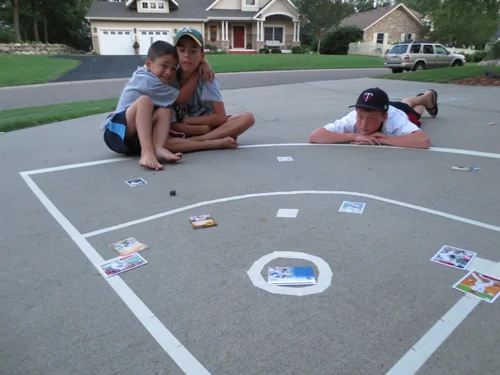
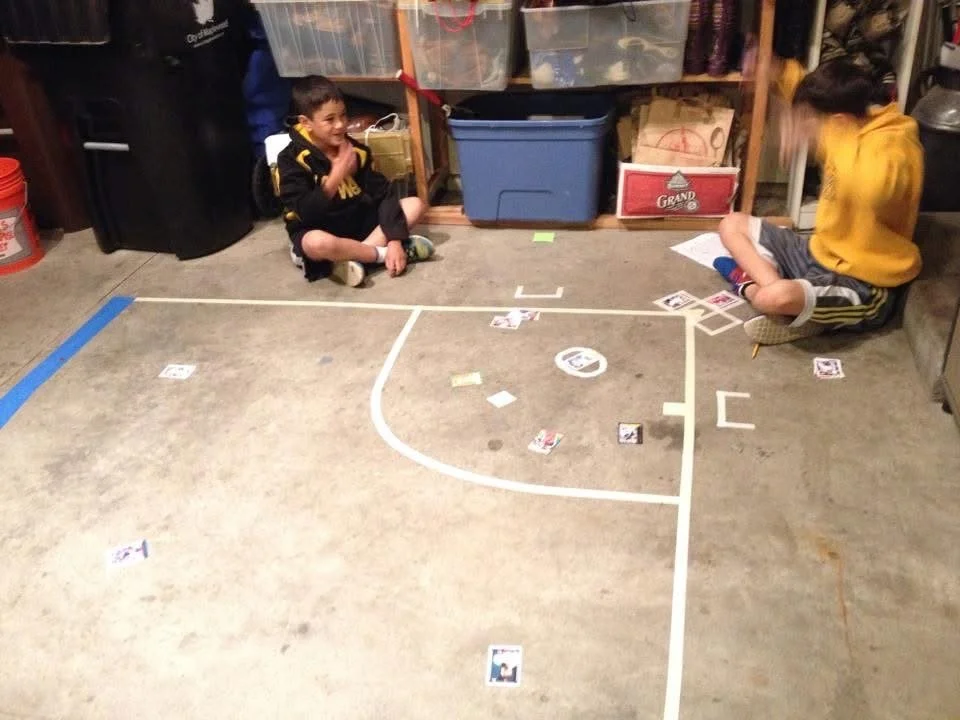
I built the first field for them. One day I came home from work and wondered where Ben and Isaac were. I found them next door in Cade’s garage. There was a pitch-the-penny field taped to the floor. I had introduced them to the game, and now my services were no longer required. They created their own fields. Made their own modifications. Invited their friends.
Looking at the pictures now, I’m reminded how seriously they took the game. Baseball cards carefully positioned around the field. Score sheets on the floor. Pennies in play. Kids sprawled across concrete trying to get the right angle on a throw. It looked a lot like us.
My boys enjoyed pitch-the-penny enough that recently they started bugging me to document the rules. To be clear, Todd Soutor and Tom Larson invented the game. I’m finally writing down the rules—as I remember them.
Maybe someday there will be a next generation sprawled across a concrete floor flipping baseball cards and arguing over whether the penny touched the outfield wall. I hope so.
In the meantime, I’m seriously considering an old-timers pitch-the-penny tournament. Get the guys from the old neighborhood together on a Saturday afternoon and play again. Almost 50 years later, our joints probably aren’t going to tolerate crawling around on a concrete floor for nine innings. We may have to create an elevated stadium on a ping-pong table or a sheet of plywood on sawhorses. We’ll need baseball cards. A die. A penny. A few rolls of masking tape. Maybe some reading glasses for instant replay. The cans of Orange Crush and Tahitian Treat will be replaced by cold Hamm’s beer. Who’s playing with me?
The Official Rules of Pitch-the-Penny Baseball
Dedicated to all the guys on the East Side of St. Paul who made the game what it is.
Copyright © 1979 or thereabouts by Soutor and Larson
First documented edition, 2026
No rights reserved—have fun with it, make the game your own
What You Need
1 six-sided die
1 penny
9 baseball cards per team (but we always had bench players)
A few rolls of ¾” or 1” masking tape
Scorebook or scoresheet
Flat, smooth surface. A concrete basement or garage floor works best. NOTE: A driveway is not as smooth and rain will play havoc on your field.
Constructing the Field
You need a smooth, flat concrete surface to construct the field. Ensure that there is enough space surrounding the field for the players to physically maneuver during the game.
Identify where home plate will be and using masking tape create a home plate about 2” wide.
This is the only tricky part in constructing your field. Had I paid more attention to Len Horyza in high school geometry, I could figure out the precise angles and distances. I would tell you that a baseball field is 90 feet between bases and a 45-degree angle from home plate to first base and a 90-degree angle between first and second base — making it 127.3 feet between home plate and second base. I would then convert that into the number of baseball card lengths. Instead, we are going to use a couple of yardsticks or pieces of straight wood and a little trial and error to get things right. Lay down one yardstick with one edge straight down the center of home plate toward centerfield. Lay down another yardstick in the direction of first base at that 45-degree angle. Adjust the angle of the first base yardstick until both a.) the distance between home plate and first base equals 5 baseball card lengths, and b.) the distance between first base and second base equals 5 baseball card lengths. Voila, you have a 45-degree angle and a 90-degree angle.
You are halfway done with the hard part. Now do the same to figure out a.) the distance between second and third base, and b.) the distance between third base and home. Obviously 5 card lengths each. With a pencil mark the location of each base, create the 3 bases out of masking tape (approx. 2”x2”) and put them in position.
Now the fun and creativity begin. Besides the distance between bases, all the other dimensions and features of the field are up to you.
Using masking tape, lay down your baselines. Then extend the first- and third-base lines into the outfield as foul lines. You can make the field any dimensions you want. For perspective, 5 card lengths = 90’ between bases. The average distance of an MLB baseball field is 330’ down the right field and left field lines. (TIP: between home and first base and third base and home, use a pencil to mark the five card lengths.)
Create your outfield fence in any shape or width that you want. Again, for reference the average MLB field is 403’ to dead center field.
Create a pitching rubber about halfway between home plate and second base. We always created a circle around the rubber to simulate a pitching mound.
Other features that we often created as part of our stadiums included: batter’s boxes, catcher’s box, dugouts, bullpens, a warning track, logos cut into the “grass.”
Progression of Play
Exchange Lineup Cards
A byproduct of pitch-the-penny baseball is learning how to properly keep a baseball scoresheet. This starts with opposing managers exchanging their lineup cards.
Play Ball – Defense
The defensive player lays 9 cards in field of play as they would be positioned in a real baseball game. (Tip: first baseman should have some part of their card touching 1st base for a potential force out.)
Batter Up
Offensive player places the card of their first batter in batter's box on the field.
Pitching
The defensive player pitches the ball by rolling the die. The outcome of the pitch is determined by the result of the roll with the following values:
2 or 3 = strike
4 or 5 = ball
1 or 6 = hit ball
Pitch count is the same as in baseball. Four balls = walk. Three strikes = strikeout. For us a 2 for the third strike was a swinging strikeout and a 3 was looking. A foul ball counts as a strike for the first and second strike.
Hit Ball
When the result of the pitch equals 1 or 6, the offensive player sits behind home plate and without their hand extending past home plate, tosses a penny. Except when the penny touches a defensive player, where the penny ultimately comes to rest determines whether the hit is fair, foul or beyond the outfield wall.
If penny lands in foul territory = foul ball
If penny goes past outfield wall = fly out
If any part of the penny rolls or slides over a defensive card in the field = line out or fly out
If any part of the penny stops on tape marking the outfield fence = home run
If penny lands in the field of play without first hitting a defensive card = the ball is in play
Example scenarios:
A. A tossed penny rolls over or touches a defensive card in any way and then stops on the outfield wall (home-run tape) = a fly-out because it first touched a defensive card.
B. A tossed penny rolls into foul territory or beyond the outfield wall, but ultimately lands in the field of play = the ball is in play.
C. A tossed penny rolls over or touches a baserunner that is not touching a base = baserunner is out for interference, the ball is dead, batter gets first base.
Ball in Play
Once a ball is put in play, defense and offense alternate turns. Each rolls the die to determine the number of moves allowed. The defense uses its moves to field and throw the penny. The offense uses its moves to advance the batter and any baserunners. Play continues until the ball becomes dead or the third out is recorded.
The defense gets the first opportunity to field a ball in play. On this first defensive turn, reaching the penny with a defensive card before using all available moves results in a catch and an out. Until that first defensive turn is completed, the penny is considered to still be in the air.
Defense
Defensive player rolls 1 die. The value on die represents the number of card flips and/or throws that defensive card(s) can move.
IMPORTANT: A card is flipped by placing a finger along one edge and flipping it end-over-end—along the full edge to move in a straight line or from a corner to change direction.
The defensive player flips their card (or any combination of cards) equal to the number on the die.
If any part of the defensive card reaches/touches the penny on the first die roll = a fly out (if it barely touches the penny it is a "shoestring catch")
If not, the ball hits the ground in play
Offense
If the ball hits the ground in play, the offensive player rolls one die. The value on the die represents the number of card flips the offensive card(s) move to run the bases.
IMPORTANT: A runner is safe when any part of his card touches the base.
Initially rolling/running "out of the batter's box":
6 = safe at first and rounded the base — the runner is one card length toward second yet still touching first base
5 = safe at first
1 through 4 = running down first base line (1 is a "stumble out of the box")
Important: In situations where there are runners already on base:
If there is a runner behind, the runner on base is forced to advance. All runners advance at the same pace. For example, there is a runner already on first base and a 3 is rolled, both the batter and runner on first base advance 3 flips.
If a runner is not forced to advance, the offensive player must declare before rolling the die whether that runner will attempt to advance. If they are advancing, all runners advance at the same pace. For example, there is a runner on second base and first base is empty, if the offensive player declares that they are all advancing and a 2 is rolled both the batter and runner on second base advance 2 flips.
Defense
If the defense did not reach the penny on its first turn, the ball has hit the ground and remains live. The defensive player rolls the die again. The value on the die represents the number of card flips that defensive card(s) can move and throw.
Throws are made by placing your index finger on the penny and sliding the penny across the surface.
If any part of the thrown penny touches another defensive card, that player has caught the ball. (Even if the penny stops beyond that defensive card)
If the penny does not touch a defensive card, the ball hits the ground at the spot the penny stops and remains a live ball.
Example based on what you know so far:
A hit penny landed in right-center field. In the first defensive play the player flipped their right fielder toward the penny but did not catch the ball. The ball hit the ground and is live.
The offensive player rolled a 2 and advanced the batter 2 flips toward first base.
Defense rolls a 4 (allowing 4 moves)
Defensive player flips the right fielder card toward the penny. The card touches the penny on the second flip securing the ball. (=2 moves)
Defensive player then throws the ball (slides with index finger) toward the first baseman. (= 1 move for a total of 3).
If the penny touches the first baseman (either rolls over or lands on) and the card is touching the base, it is a force out.
If the penny does not hit the first baseman’s card, the defensive player can use the remaining move to flip the first baseman toward the penny. If on that flip the card touches the penny, the ball is secure and being held by the first baseman (= 1 move for a total of 4).
Offense
If the batter did not safely reach 1st base on their first roll, the offensive player rolls 1 die. The value on the die represents the number of card flips the offensive card moves to run the bases.
If the batter has still not safely reached 1st base the play moves to the defensive player.
Example (remember there are 5 card lengths between bases):
On the first offensive play the offense rolled a 2 and the batter is 2 card lengths toward 1st base
If on second roll the offense rolls:
1 = runner is 3 card lengths toward 1st base and still not safe
2 = runner is 4 card lengths toward 1st base and still not safe
3 = runner has safely reached 1st base
4 = runner has safely reached 1st base and rounded the corner
5 or 6 = runner can choose to stay safely on 1st base or choose to progress toward 2nd base
Play continues as in a real baseball game until there is a “dead ball” (i.e., the defense has possession of the ball and the offense has declared they are not advancing any baserunners). At each dead ball, the defensive player is allowed to reposition his cards anywhere, within reasonable baseball positioning (i.e., you still need a pitcher and catcher in position).
And the next batter steps into the batter’s box.
Other Plays and Scenarios
Here are additional scenarios that come up during play of the game:
On a walk, place the batter on first base and advance any runners forced to the next base. You don’t actually flip the cards.
Same with a home run – no need to flip the individual cards around the bases. Although we did often recreate a ceremonial trip around the bases with the card.
Tagging out a runner who isn’t forced is achieved when a defensive card holding the penny touches the runner.
Tagging up. With fewer than two outs, if a fly ball is caught and there is a runner on base, the offensive player can declare that the runner is tagging up. As in baseball the runner must be touching the base when the catch is made. If the defensive player has remaining moves, they can use those remaining moves (e.g., throwing to the infield). Once the defensive player is out of moves, the offensive player then rolls to advance their baserunner(s).
Stealing bases. The offensive player must declare a steal before the pitch. After the pitch is rolled, the offense rolls the die and advances the stealing runner(s) accordingly. If the pitch is a 1 or 6, the play becomes a hit-and-run. If the pitch is a 2, 3, 4 or 5, the defense attempts to throw out the runner. The defense then rolls the die, with the catcher in possession of the penny, and attempts to throw out the runner.
SPECIAL EXCEPTION: If on a throw from the catcher to second base any part of the penny touches the pitcher card, it is not considered to be caught by the pitcher.Throw out of play. If a thrown penny happens to roll to where it is unretrievable (e.g., under a workbench or Mr. Bobick’s woodworking tools) the ball is considered out of play. It’s a dead ball and the runners advance as they would in baseball.
Other Traditions and Quirks
Homerun. When a home run is hit, commemorate it by tracing the outline of the penny where it landed. Inside the circle, write the player's name, the date and the made-up distance of the home run.
Ground rule double. If a field had a warning track, when a hit penny landed on the warning track it was ruled a ground rule double with the cards advancing as appropriate.
The Draft. We held a draft to select teams, including starters at each position, backups, bullpen pitchers and a designated hitter.
Warm-up pitches. The defensive player rolled the die for warm-up pitches before the start of each inning.