I Do Understand
Bryan Koemptgen | September 2026
As a good Catholic boy, moving to a new country is no excuse to not attend regular Mass. Years have gone into conditioning my guilty Catholic conscience. It will not allow it. Plus, I was longing for some structure and something familiar in my new city.
I needed to find a church. Easy enough in Europe. Churches are everywhere, or at least that is what you would think from tourist photos.
Within days of moving into our new apartment, I was super excited to discover Frauenfriedenskirche (The Church of Our Lady of Peace) two blocks away along a tree-lined parkway. It is a stunningly beautiful building with huge arches and striking mosaics both inside and outside. Its history is also unique. It was constructed mostly on the initiative of women who lost family members in World War I, as a reminder of the importance of peace.
Beautiful Catholic church. Two blocks from our apartment. Problem solved.
Then I went to Mass. It was mostly empty. Not completely empty. Empty enough that you notice. I went back other Sundays and it was generally the same. Then on the Sunday after Easter I wandered in a few minutes late and the place was packed. Standing room only. Where did all these people come from? Then I realized it was First Communion Sunday. Which led to another question. Where are all these families every other Sunday?
I started exploring other churches. Six so far.
I should probably stop here and explain something. I'm not a theologian. I may get some of the terminology and the official Catholic teaching wrong. What follows is my experience and my understanding of it. I was, however, an altar boy so that should give me some street cred.
I also attended Catholic grade school from fourth through eighth grade, an all-boys Catholic high school run by the Christian Brothers and a Benedictine university. So I’m no stranger to Catholic teaching and churches.
At St. Pascal Baylon grade school on the East Side of St. Paul, the Sisters of St. Joseph were in charge. Being an altar boy was a great experience, although probably not always for the reasons the Church intended. Every altar boy wanted to get selected to serve at funeral Masses because funerals usually happened during the school day. Funeral Mass meant getting excused from class and the excitement of firing up the incense burner. After Mass we filled our uniform pockets with unconsecrated hosts and headed out to the playground to share our stolen loot with buddies. I realize there may be several theological issues packed into that last sentence.
If we served weekday morning Mass, Father George Grafsky would toss us a dollar or two after Mass. Cash in hand, we walked over to Winchell's Donuts for apple fritters the size of my face.
Father George also took me to my first R-rated movie, The Blues Brothers, at age 12. It was me and two buddies, Dan Schaffer and Steve Fichtel. Our parents didn’t even blink at three 12-year-old boys attending an R-rated movie. I assume Father George provided us with sufficient cover. After the movie we stopped at White Castle for sliders and onion chips.
There were also the nuns. Sister Eugenia was our middle-school science teacher. Strict but fair and an outstanding teacher. She was quite an imposing figure in her full habit—white in summer, black in winter. In her habit she seemed to float through the hallways or across the playground like The Penguin in The Blues Brothers. What I remember most about Sister Eugenia, though, was her explaining in science class how you could be Catholic and still believe in evolution.
Later, in high school, Sister Jane was always extolling us to "save our shekels" so we could travel Europe someday. Guess what, Sister Jane. I listened.
There was also Brother Martel standing in the doorway of his classroom in his black tunic. His booming bass voice carried through a hallway full of high school boys moving between classes. Most likely he was calling out students by name for various uniform violations or missing assignments.
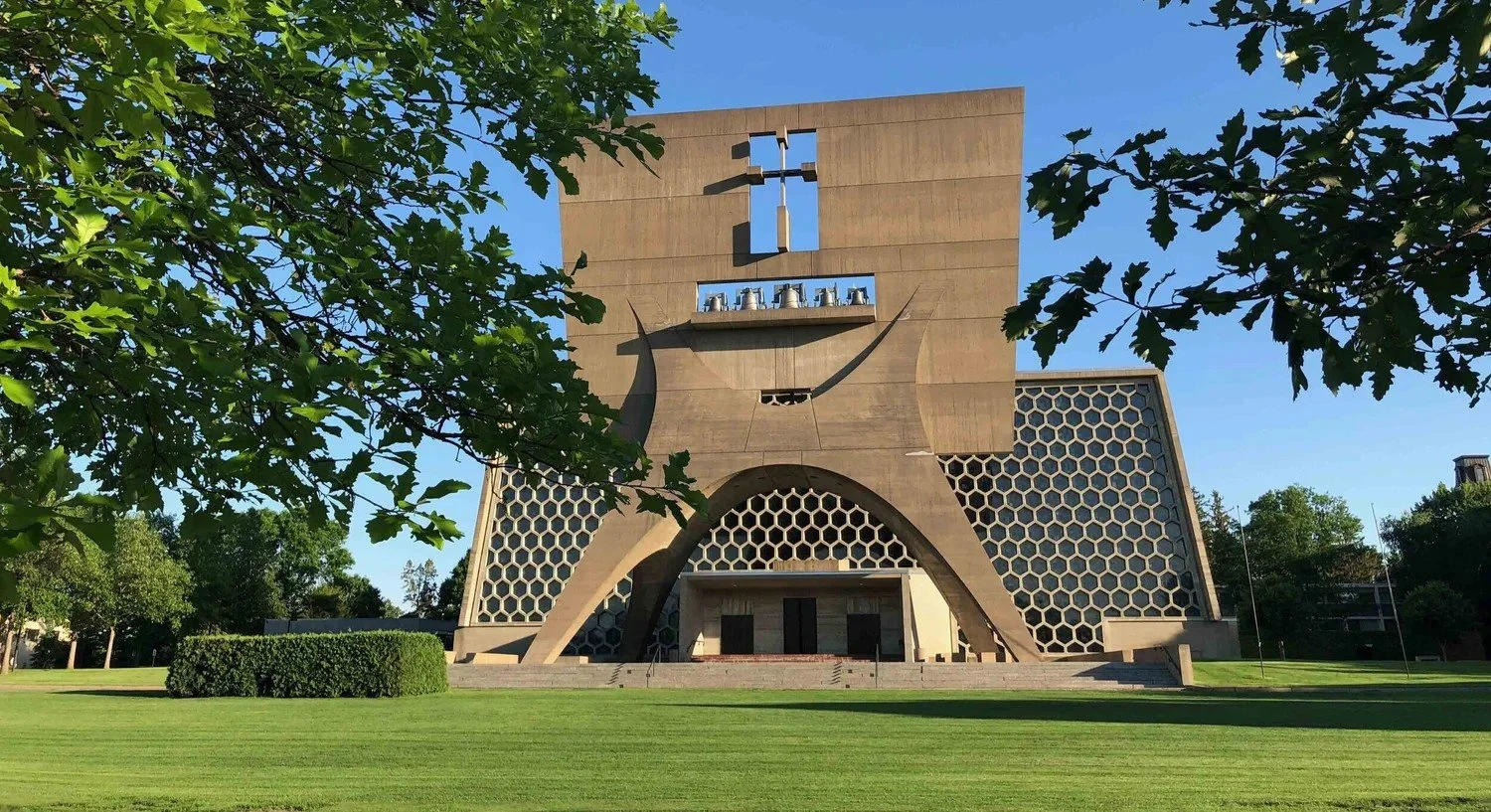
By the time I got to Saint John's University in Collegeville, Minnesota, my experience with the Church was changing. While living on campus during my freshman and sophomore years, I would regularly attend the weekday evening Mass at the Abbey Church. Precisely at 4:57 PM the Benedictine monks started processing into the church singing Gregorian chant. The monks and everyone else sat in individual choir stalls arranged in a semicircle around the altar. On most days I would fall asleep at some point during Mass. But I kept going. I enjoyed the ritual, the space and the repetition. It created a familiar environment where I could slow down and reset before heading off for an evening of studying. Years later I learned that the Jesuits have a word for something like this: being "predisposed." (I wrote about that in an earlier story, The Other Kind of Silence.)
I wasn't thinking about any of that when I started looking for a church in Frankfurt. I thought I was just looking for Mass. Preferably in English.
An obvious place to start was the Imperial Cathedral of Saint Bartholomew in the center of Frankfurt. There has been a church on the site since the seventh century. When I first visited, parts of the Cathedral were under renovation. It was cool to think about how this place has existed and continued to evolve for more than a thousand years. Royal elections and coronations took place here. Its history runs through the Holy Roman Empire and the Reformation. But I discovered something much more important to me. They have an English-language Mass. Saturday at 5:00 PM. Perfect. Except somehow I can never get myself to the Cathedral by 5:00 on Saturday.
I tried a few neighborhood churches including St. Elisabeth in Bockenheim and St. Bernhard in Nordend. Both beautiful neighborhood churches. Sparsely attended. The great brunch spots around St. Bernhard keep me thinking we will go back someday. One of the things Germans do exceptionally well is Sunday brunch. Sweet or savory, take your pick. Nobody seems to be in a hurry. Family and friends sit around a table eating and talking for hours. It’s a great follow-up to Mass, but St. Bernhard isn't particularly convenient by public transportation, so I kept looking.
Then I discovered an English-language Mass at Holy Cross on the Feast of the Ascension. Finally. An English Mass that was only a U-Bahn ride away. The congregation was almost an equal mix of Africans, Asians, Europeans and Americans. I remember thinking this might work. Then, at the end of Mass, they announced that the weekly English Mass was moving way out into the suburbs. Of course it was.
Eventually I found Liebfrauen.
Liebfrauen (Church of Our Lady) sits on the edge of Frankfurt's old town, just around the corner from the Hauptwache U-Bahn station. From our apartment I walk to the U-Bahn, take the U6 or U7 train four stops, get off at Hauptwache and walk about a block.
Technically Liebfrauen is the church attached to a Capuchin monastery. Or maybe it's their chapel. I honestly don't know the difference. What I do know is that the place is packed. Every time I go. Always standing room only.
I don't speak to anyone before Mass. I don't speak to anyone during Mass. I don't usually speak to anyone afterward. But I appreciate all those people there. I want to feel like I'm celebrating with other people rather than sitting by myself in a beautiful, mostly empty building. Clearly, I want a sense of community even if I don’t actually talk to anyone in the community. Which is quite German. So maybe I fit in more than I think.
I had always thought of Germany, and this part of Europe in general, as being very Catholic. However, after experiencing so many sparsely attended Masses I jumped into some internet research. Turns out I was partly right.
At the end of 2025, about 23 percent of Germans were officially registered as Catholic. But only 6.8 percent of those registered Catholics regularly attended Catholic worship. That works out to roughly 1.5 percent of the German population. About one person out of every 64.
Those empty pews make sense. Germany has a lot of Catholics on paper. Just not necessarily in church on Sunday.
Liebfrauen is different. It’s full. There is just one problem. Mass is in German. Obviously I don't speak German. At my first few Masses I simply sat through the Liturgy of the Word. I knew there was a first reading. I pretended to sing along with the psalm. I knew there was a second reading. I stood for the Gospel. I just had no idea what anybody was saying.
Each week I sat through the Liturgy of the Word and thought, “next week I will look up the readings online and read them before going to Mass.” Great plan. Poor execution. And once I’m sitting in church, I don’t want to pull out my phone and start scrolling.
On to Plan B. During my last trip back home I took my parents to Mass at their church and just happened to walk out with a copy of the book containing the readings for the entire year. Did I steal it? Did I borrow it? I'll have to sort that out the next time I go to confession.
Now I follow along by reading in English. Then comes the homily. I have to be honest. Over my lifetime I have probably slept through at least some portion of 80 percent of the homilies at Masses I've attended. Consequently, with the homily in German I’m not missing very much.
When I started seeking a church to regularly attend in Germany, I was confident the language wouldn't get in the way of what mattered most. The most important part of the Catholic Mass never requires translation.
Unlike many other Christian services that center primarily on scripture and preaching the Gospel, the center of the Catholic Mass is not the readings or the homily — it's the Eucharist. Catholics believe that during the consecration the bread and wine become the body and blood of Christ. We believe Christ becomes truly present under the appearances of bread and wine, and that the sacrifice of Christ is made sacramentally present.
I can sit through the readings without understanding them. I can sleep through a homily. But when the priest begins the consecration, I know exactly where we are. I know exactly what is happening.
And then the bells start ringing. Not the little bells the altar servers ring during the consecration. The big ones. The bells in the tower. You are kneeling while the priest is praying in German and you hear these enormous church bells ringing outside over the middle of Frankfurt. There is something ominous about it. Something sacred is happening.
The first time we heard the bells there was no visible reaction during Mass. We played it off like it was no big deal. But as we walked home the first thing I said was, “Holy shit, how about those bells? Wasn’t that cool?” Jennifer responded, “I felt the same thing.”
I can't understand the words. But I know exactly where I am.
I learned that language a long time ago.
At St. Pascal’s with the Sisters of St. Joseph. Serving funeral Masses so I could get out of class. Eating stolen hosts on the playground.
The Christian Brothers instilling discipline at Cretin High School.
Sitting in a choir stall at Saint John's while Benedictine monks processed past singing Gregorian chant. Sometimes paying attention. Sometimes sleeping. Mostly just being present for the gift of the Eucharist.
I don't think Sister Jane had this particular outcome in mind when she told us to save our shekels so we could travel around Europe someday. But here I am. Riding the U-Bahn through Frankfurt on Sunday mornings to attend Mass in the language I do understand.